High blood pressure usually has no symptoms until it has already done damage, so most of the people who have it don't know they do. It's now one of the most common conditions in Africa.
How common is high blood pressure?
In Africa, up to 44% of adults aged 30 to 79 have high blood pressure. In most countries, fewer than half have been diagnosed, and fewer than one in five have it under control.
It's common in the Caribbean too. In Jamaica, 33.8% of people aged 15 and over have it, and in Barbados, 40.7% of adults aged 25 and over.
In the United States, 58% of Black adults have it, against 44.5% of adults overall.1
How do you check your blood pressure?
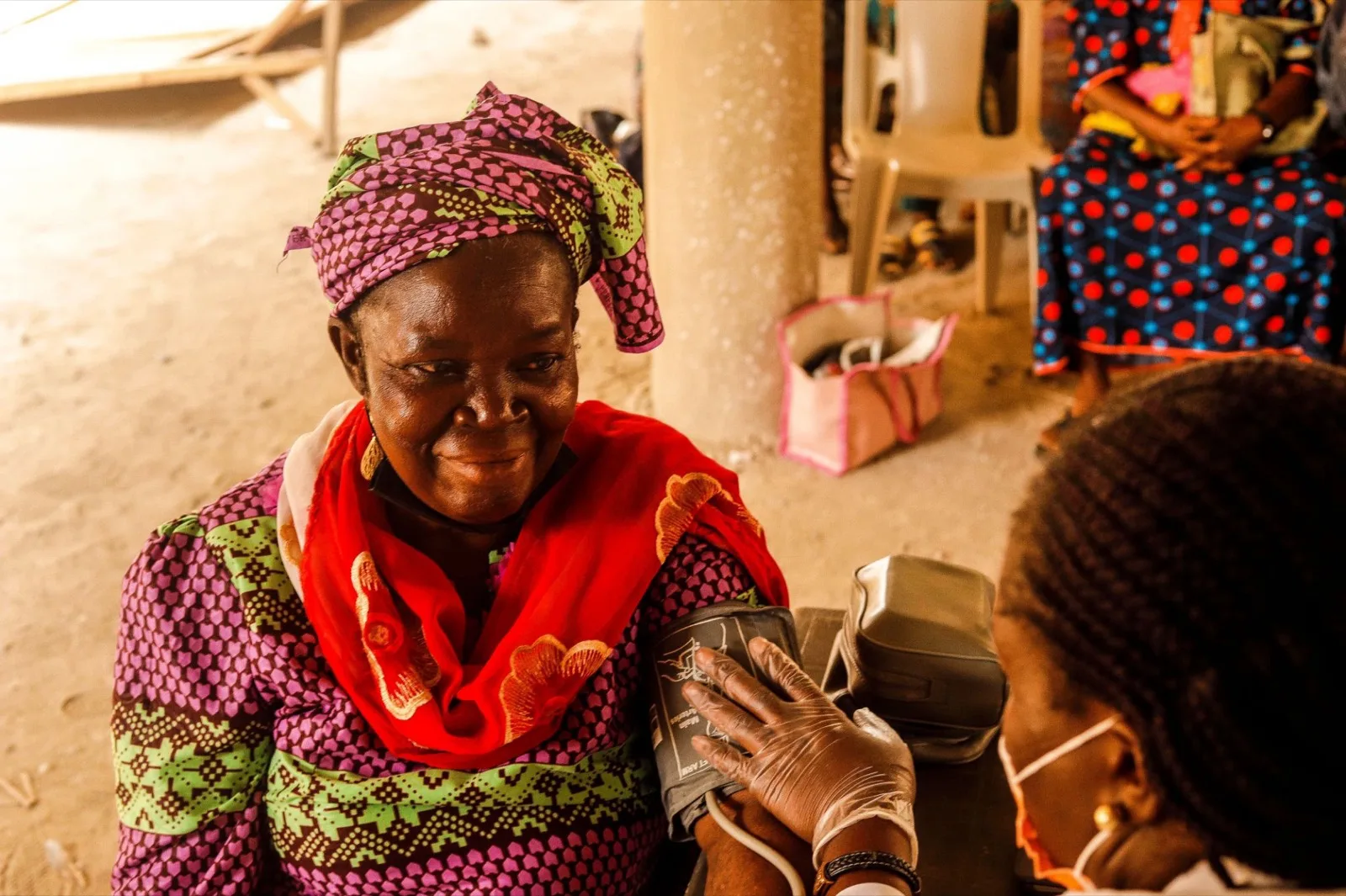
Most people have no symptoms, so you can't feel your way to a diagnosis. Meanwhile high blood pressure is damaging your heart, your kidneys and the small vessels in your brain, which is how it causes stroke. Get it measured. Pharmacies, clinics and many workplaces will do it free or for a small fee, and it takes about two minutes.
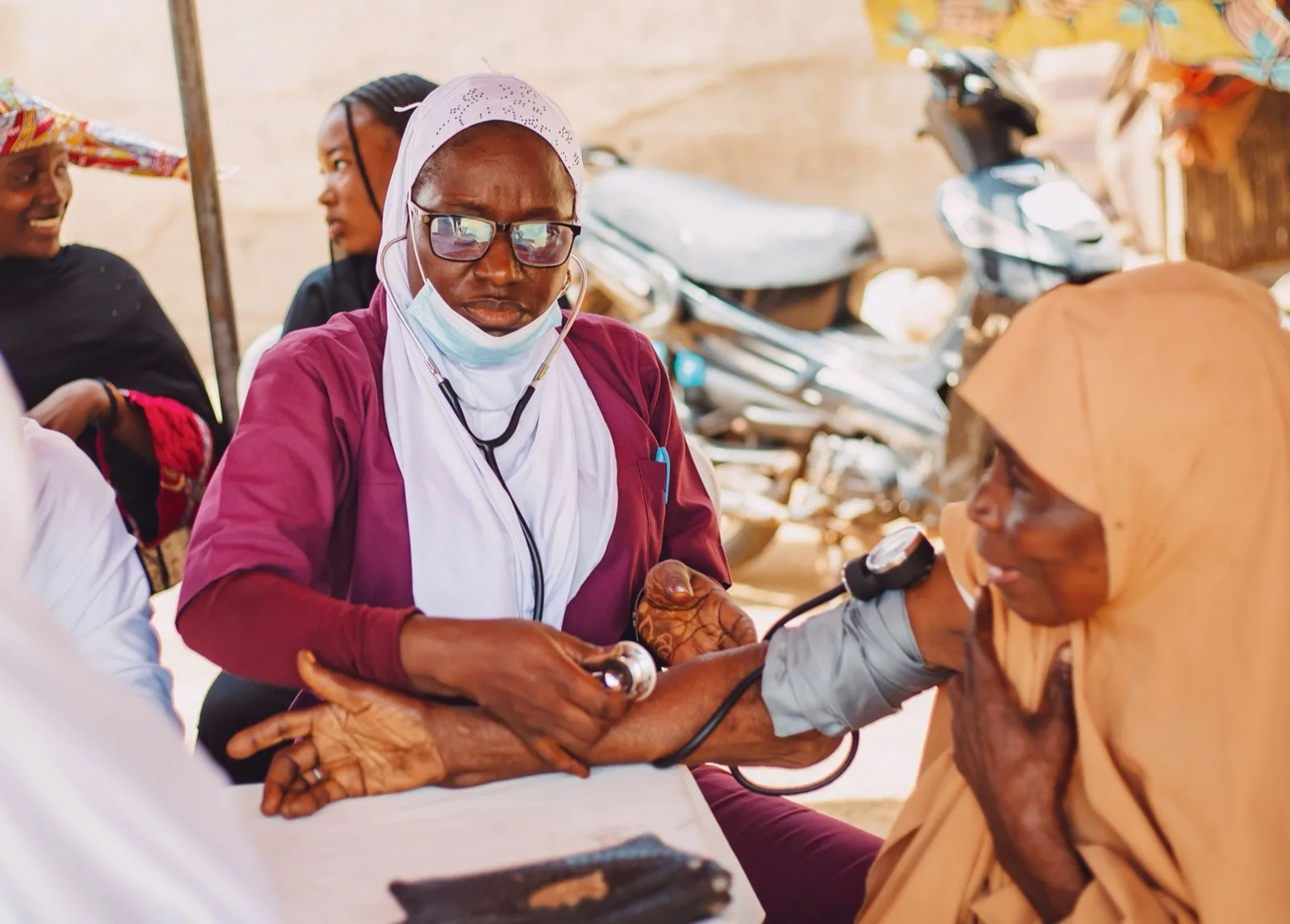
The machine wraps a band around your upper arm, called a cuff, and squeezes until it can feel the blood moving. You get two numbers. The top one is the pressure while your heart pushes. The bottom one is the pressure while it rests between beats.
The line is 140 over 90. African heart doctors keep that line and have chosen not to follow the United States down to 130 over 80. If you check at home, the line is lower, 135 over 85, because just being in a clinic can push your pressure up. That's common enough to have a name: the white coat effect.
Many things raise your blood pressure for a few minutes. A climb up stairs, a rush through traffic, a cup of coffee. So one high reading isn't a diagnosis, which is why the guidance for Africa says to measure on three separate occasions inside four weeks.
When someone measures you:
Sit still for five minutes first, with both feet on the floor.
Rest your arm on a table at the height of your heart.
Stay quiet while the cuff is squeezing.
Take two readings a minute apart and write both down.
If you buy a home machine, choose one with a cuff for the upper arm, and take it to a clinic once to check it against theirs. Home machines in the region aren't always accurate, so that one check matters.
If your last reading was normal or borderline, have it checked again within three years. If it was borderline and a health worker says you're at higher risk, once a year. If it's been high, your health worker will tell you how often.
Why is it so difficult to control?
African heart doctors give three reasons. Many people were never tested, so they didn't know they had it. Others couldn't get treatment, or couldn't keep taking it. For the rest, nobody checked whether the treatment was working.
Jamaica's national health survey shows how that last one could go wrong. In that survey, most people with high blood pressure knew they had it, and most of them were taking medicine. Yet only about one in eight of them had a blood pressure reading in the safe range.
Treatment works better when a health worker can monitor your blood pressure. They may need to change the dose of your medicine until it comes down. So when you collect a prescription, ask what your reading is, and ask when someone will check it again.
Is high blood pressure in your genes?
If someone in your family has high blood pressure, you're more likely to have it. But family history is about your own risk. It doesn't explain why whole countries have rates this high.
In the 1990s, researchers measured the blood pressure of just over ten thousand adults of West African descent, aged 25 and over. They used the same method in Nigeria, Cameroon, Jamaica, St Lucia, Barbados and the United States.
The rates climbed steadily. About 16% had high blood pressure in West Africa, 26% in the Caribbean and 33% in the United States. Everyone in the study shared West African ancestry, so ancestry couldn't be the main thing. Body weight went up alongside the rates, and so did the amount of salt people ate compared with the potassium in their food.
Age shows the same thing. Among people aged 25 to 34, blood pressure was much the same wherever they lived. The gap between the places opened as people got older, and it opened twice as fast in the United States.
The climb from West Africa to the United States has since flattened. Researchers later pooled 1,201 studies covering 104 million people. Between 1990 and 2019, high blood pressure became less common in rich countries. In most poorer ones it rose, or held steady.
Nobody's genes moved in those thirty years. Diets, weight, work and health services did.
How much salt is too much?
The World Health Organization advises less than 5 grams of salt a day, which is just under a teaspoon. The typical Nigerian adult eats nearly 10 grams, and the typical Ghanaian adult just over 8. Almost everyone is over: 97% of Nigerian adults and 77% of Ghanaians.
The Nigerian study also traced where that salt comes from.
Where a day's salt comes from
62.1%
24%
8.6%
5.3%
62.1% Added by hand
24% Street and restaurant food
8.6% Already in the ingredients
5.3% Not accounted for
Dietary sources of sodium intake in Nigerian adults, Scientific Reports (2025) — read it
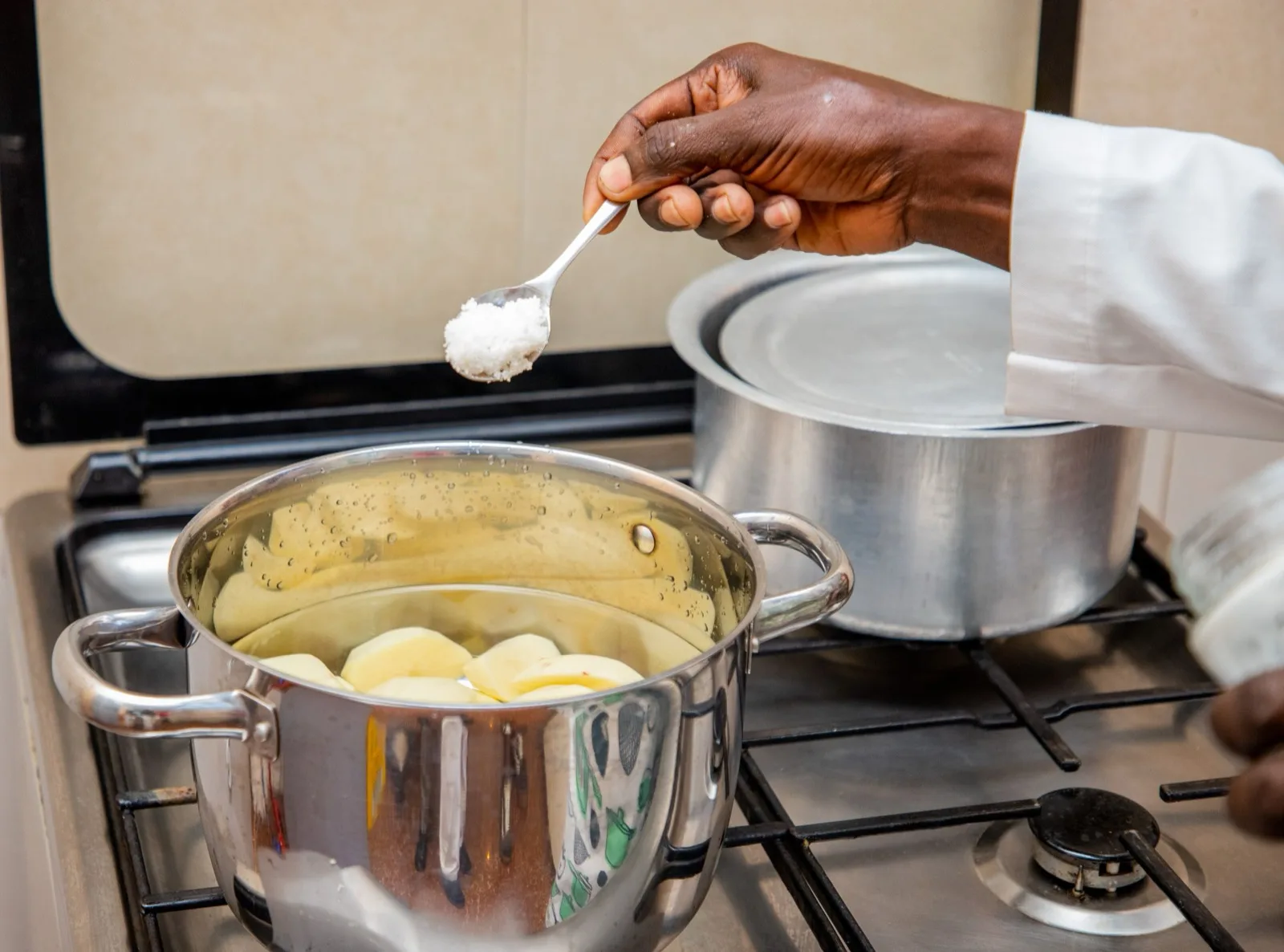
Almost two thirds is added at home, by hand, while someone is cooking or at the table. More of that comes from seasoning cubes and spice mixes than from salt itself. You can change that without buying anything different. Street food and restaurant food account for another quarter, and only 8.6% is already in the ingredients. Just 10.7% is added at the table, so most of it goes into the pot.
The other half of the picture is potassium, which pushes blood pressure the other way. In Ghana, 65% of adults were below the recommended amount. The 1990s study found the same pairing: as the rates climbed from West Africa to the United States, salt went up and potassium went down.
You don't have to cook without flavour. Use more pepper, garlic, ginger, onion, curry, thyme and citrus, and cut the cubes by half over a few weeks so your tongue adjusts. For potassium, eat more leafy vegetables, beans, avocado and fruit. Hibiscus tea, which is zobo without the sugar, is on the list African heart doctors recommend.
What else makes a difference?
Weight. Across weight-loss trials, people who lost about five kilograms lowered the top number of their blood pressure by about four points. That's roughly one point per kilogram.
Movement, of the kind you already do. Walking, dancing, cleaning the house, playing football. The World Health Organization says to do 150 minutes a week.
Poor sleep and long-running stress. Both push the numbers up. For sleep, our Sleep better tool helps you find what's wrong and fix it.
Your other medicines. Some painkillers taken often, some cold remedies and some herbal mixtures push blood pressure up. Take any packets to your health worker for advice, including anything you bought without a prescription.
Take your medicine every day, at the same time, whether or not you feel well.
Tell your health worker about side effects before you stop taking anything. There are several families of blood pressure medicine and a different one may suit you better, though finding it can take a few tries.
Keep a record. Write the date and the reading in a notebook or your phone, and take it to appointments. A health worker can do far more with six readings over three months than with one reading today.
Check your number this month, and get your family to check theirs.
These four surveys cover different ages, and the American figures count from 130 over 80 after the United States lowered its threshold in 2017, while the African and Caribbean figures use 140 over 90. Jamaica's survey measured both ways on the same people and got 33.8% at the higher line and 57.6% at the lower one. Moving to 130 over 80 would add millions of patients across Africa, without good evidence that treating them earlier helps. ↩
Questions this piece answers
Can I stop my tablets when my blood pressure is normal?
Your blood pressure is normal because of the medicine. Stopping without asking your health worker lets the pressure climb again, and you may not feel it happening.
World Health Organization Regional Office for Africa. (2026). World Hypertension Day 2026 message. www.afro.who.int
Jones, E. S. W., Damasceno, A., Ogola, E. N., Ojji, D. B., Dzudie, A., & Rayner, B. L. (2020). PASCAR commentary on the International Society of Hypertension global guidelines 2020: Relevance to sub-Saharan Africa. Cardiovascular Journal of Africa, 31(6), 325-330. doi.org
Ministry of Health and Wellness, Jamaica, & Caribbean Institute for Health Research. (2024). Jamaica Health and Lifestyle Survey 2016-17. www.moh.gov.jm
Unwin, N., Rose, A. M. C., George, K. S., Hambleton, I. R., & Howitt, C. (2015). The Barbados Health of the Nation Survey: Core findings. University of the West Indies and Barbados Ministry of Health. www.health.gov.bb
National Center for Health Statistics. (2024). QuickStats: Age-adjusted percentage of adults aged 18 years and over with hypertension, by sex and race and ethnicity, United States, August 2021-August 2023. MMWR, 73(48), 1110. www.cdc.gov
Cooper, R., Rotimi, C., Ataman, S., McGee, D., Osotimehin, B., Kadiri, S., Muna, W., Kingue, S., Fraser, H., Forrester, T., Bennett, F., & Wilks, R. (1997). The prevalence of hypertension in seven populations of west African origin. American Journal of Public Health, 87(2), 160-168. doi.org
NCD Risk Factor Collaboration. (2021). Worldwide trends in hypertension prevalence and progress in treatment and control from 1990 to 2019: A pooled analysis of 1201 population-representative studies with 104 million participants. The Lancet, 398(10304), 957-980. doi.org
Dietary sources of sodium intake in Nigerian adults: A population-based cross-sectional study. (2025). Scientific Reports, 15. www.nature.com
Menyanu, E. K., Corso, B., Minicuci, N., Rocco, I., Zandberg, L., Baumgartner, J., Biritwum, R. B., Gomez-Olive, F. X., Mensah, G., Kowal, P., & Charlton, K. E. (2020). Salt and potassium intake among adult Ghanaians: WHO-SAGE Ghana Wave 3. BMC Nutrition, 6, 54. doi.org
World Health Organization. (2025). Sodium reduction (fact sheet). www.who.int
World Health Organization. (2025). Hypertension (fact sheet). www.who.int
National Health Service. (2025). High blood pressure (hypertension). www.nhs.uk
Neter, J. E., Stam, B. E., Kok, F. J., Grobbee, D. E., & Geleijnse, J. M. (2003). Influence of weight reduction on blood pressure: A meta-analysis of randomized controlled trials. Hypertension, 42(5), 878-884. doi.org