Is it safe to stop drinking on your own?
For most people, cutting down at home works with a plan. For heavy daily drinkers, stopping suddenly can be dangerous.
For most people, cutting down at home works with a plan. For heavy daily drinkers, stopping suddenly can be dangerous.
You've decided to stop drinking, or at least to cut down. Before learning how, you need to know whether it's safe, because for some drinkers stopping suddenly is dangerous.
If alcohol has been in your blood most days for a long time, your body adjusts to it being there, and that adjustment is what makes a sudden stop risky. The signs of this adjustment show up after the longest stretch your body has gone without a drink, which for most people is the morning after six to eight hours asleep.
Get medical advice before you stop if any of these apply to you:
Each of those is the adjustment showing itself. Alcohol slows your nervous system down, so when it's there most days your body has to set your nerves faster to stay level. Remove the alcohol and that extra speed has nothing to slow it down. Hence the shaking and the sweating.
Past seizures or hallucinations count even if your mornings are fine now. How your body reacted the last time you stopped is the clearest sign of how it could react this time.
None of this means you can't stop. It means the first step is a doctor, and what you need is called supported withdrawal. That's a short course of a medicine from the diazepam family, reduced over about a week, alongside thiamine to protect the brain. It turns a dangerous week into a far safer one.
Whichever group you're in, the next step is the same: work out how much alcohol you drink. The standard way is to count units.
A beer and a shot of rum only compare properly when you count the pure alcohol in each. That is what a unit measures. One unit is 10ml of pure alcohol, and the math is simple: millilitres multiplied by the alcohol percentage, divided by 1,000.
|
Drink |
Size and strength |
Units |
|---|---|---|
|
Bottle of lager or stout |
600ml at 5% |
3 |
|
Can of beer |
330ml at 5% |
1.7 |
|
Glass of wine |
175ml at 13% |
2.3 |
|
Shot of spirits |
35ml at 40% |
1.4 |
|
Small bottle of herbal bitters |
200ml at 40% |
8 |
|
Bottle of spirits |
750ml at 40% |
30 |
The sum needs the millilitres you actually pour, and that's where most people go wrong. A bottle or can tells you its size. A glass, a tumbler or a shared calabash doesn't, so fill yours once from a measuring jug and write the number down. Check the percentage on the label too, since some herbal bitters are stronger than they look.
Then add up a typical week.
One caution before you compare your number with anything you read online. The 10ml unit is British. The United States doesn't count in units at all, it counts in standard drinks, and one of those holds nearly twice as much alcohol as a unit.
Doctors use two things to judge a drinking pattern: a questionnaire, and a daily average. Work out your own average by dividing your weekly total by seven.
The questionnaire is AUDIT, ten questions from the World Health Organization about how much you drink, how often, and what it has cost you. A score of 20 or more is a clear reason for a specialist assessment.
UK guidance suggests assisted withdrawal for people drinking over 15 units a day, or scoring 20 or more on AUDIT. It suggests inpatient care for people drinking over 30 units a day, and for anyone who has had seizures or delirium during a previous withdrawal. It says the same for people drinking 15 to 20 units a day who also have another physical or mental illness.
Fifteen units a day is five bottles of lager. Thirty is a whole bottle of spirits. If your average sits near those figures, the next section explains what you would be walking into.
Your body needs time to unlearn the adjustment, and that happens on a timetable.
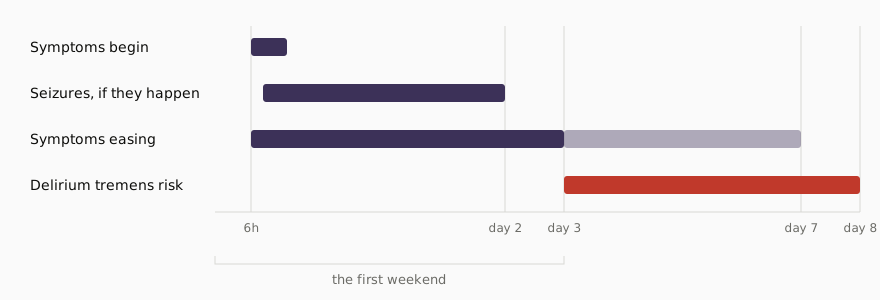
The NHS says withdrawal symptoms usually begin 6 to 12 hours after the last drink and last 3 to 7 days.
Seizures can come between 8 and 48 hours after stopping. Severe confusion with tremor, sweating and hallucinations is called delirium tremens. It affects around 3 to 5% of people in withdrawal, and the risk runs from about three days to eight days after the last drink.
So the danger reaches into the second week. Anyone with warning signs needs medical care through all of it.
That care is more than just watching. Heavy drinking strips out thiamine, a B vitamin, and without it a person can develop confusion and memory damage that never fully recovers. Thiamine tablets cost very little, and any doctor supervising a withdrawal should prescribe them.
If none of these warning signs fit you, the rest of this article is yours.
Five steps, each a few minutes.
If you slip on one of the dry days, keep the other two. A missed day is a missed day. Starting the whole plan again from Monday is how people lose a month.
Drinking doesn't happen across a week. It happens in particular half hours: the first hour after work, the walk past a familiar bar, pay day, a row at home.
Decide in advance what you will be doing at those times. A cold alcohol-free drink you like. Food before anything else. A route home that goes a different way. A call you can make on the walk.
Underneath them is the same adjustment, asking for what it expects.
Cravings don't need to be fought to a standstill. They need somewhere else to go for a while. Our article covers what the research says about riding them out, and it helps to have something to do while one passes.
Your most trying moments will have other people in them, at a party or a function, offering you a drink.
A line chosen in advance gets you past that without too much discussion. "I'm off it for now" works almost everywhere and invites no follow-up. "I'm driving" ends the conversation fastest. "Doctor's orders" is true for enough people that nobody argues with it.
Hold a glass of something — a full hand stops most offers before they start. Soft drinks, chapman, zobo or water with lime all do the job.
The pressure is usually heaviest from people who drink the way you used to. The fact that you're stopping forces other people to look at their own habits, and that can be uncomfortable for them. That's their problem to carry.
Don't expect everything to improve immediately you stop drinking. For one, sleep gets worse before it gets better.
After the first few tough nights, most people notice steadier mornings within a week, and better sleep within a month. Of course, money comes back fastest, which is why people notice it first. Add up what a normal week costs you and keep that figure visible.
Your body repairs on a longer timetable. Blood pressure falls. Liver blood tests often improve within weeks, and a fatty liver can recover if drinking stops early enough. Once scarring is advanced it doesn't reverse, so the earlier the drinking stops, the more of the liver you keep.
Mood is the slow one. If low mood was there before the drinking started, stopping may not clear it, and it deserves its own treatment.
Trying to quit and slipping tells you something useful. It usually means the plan asked for too big a jump, or that something underneath, such as anxiety or grief, needs treating.
Medicines that reduce craving, talking therapy and structured programmes all help, and a doctor can say which suits your situation.
Two medicines are prescribed most often. Naltrexone and acamprosate both lower craving, and you take them while carrying on with normal life. A doctor chooses based on your liver, your other medicines and what you want.
Add up your units for last week, and if the number surprises you, that's a good place to start.
It can be, for people who drink heavily every day. The warning signs are shaking hands, sweating, feeling sick in the morning, or having had fits or confusion when stopping before.
Sleep is usually poor for several nights and anxiety is common. Most physical symptoms settle within a week, and energy and sleep improve after that.
Both carry risk, and daily drinking raises the chance of dependence, which makes stopping harder. Your body responds to the total over a week.