Dopamine is not a pleasure chemical
The most repeated claim about dopamine is that it makes you feel good. Research does not support that claim.
Wanting something and liking it come from different brain systems. Work by Berridge and Robinson showed that when the dopamine systems in rats are switched off, the rats still enjoy a sweet taste. They still feel pleasure. They just stop chasing it.
So dopamine is about chasing. Enjoyment runs on other systems, including the ones that use the body's own opioid and cannabinoid chemicals.
You can see this split in an ordinary evening. You open WhatsApp without deciding to open it. You finish your data bundle on videos you did not enjoy. You go on Twitter to be annoyed. Wanting and liking have come apart, and dopamine sits on the wanting side.
What dopamine does in the brain
Dopamine neurons sit mostly in the midbrain. Researchers have found around ten parts of the brain that contain them, including the hypothalamus, the olfactory bulb and the retina. Only a few of these affect behaviour.
To see what dopamine does to behaviour, scientists recorded it in the brains of monkeys while they learned. In psychology, learning means making associations. These monkeys learned to associate a sound with juice—the sound came before the juice so many times that they began to expect it. A signal like that is called a 'cue', meaning something that tells you something else is about to happen.
The scientists, Schultz, Dayan and Montague, found three patterns:
- Reward better than expected: dopamine neurons fire hard.
- Reward exactly as expected: almost no response.
- Reward that does not come, or is worse than expected: firing drops below its usual level.
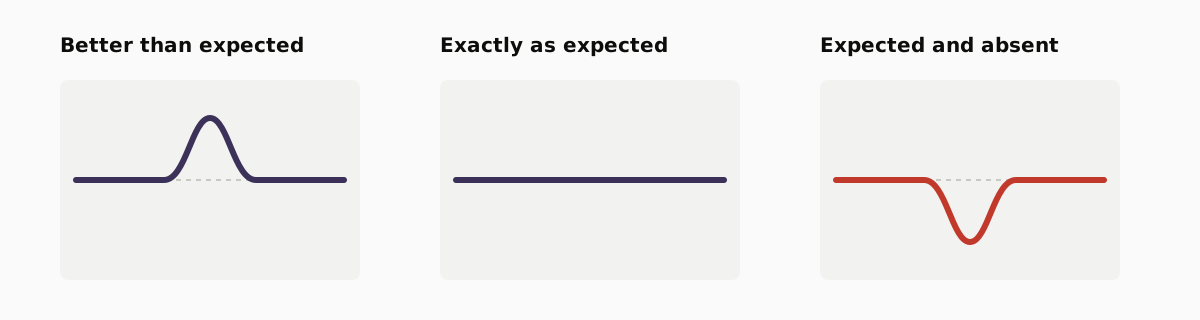
So, dopamine reports the gap between what you expected and what you got. Neuroscientists call that gap the reward prediction error.
What dopamine has to do with habits
Once a behaviour is well learned, control shifts within the brain's circuits from the regions that plan to the regions that execute. Brain activity that was spread across the whole sequence now gathers at its start and its end, and the middle runs without supervision. The dopamine response moves backwards in time, from the reward to the cue.
That is a habit, and it is why a habit feels different from a decision. The cue starts it, dopamine fires, and the sequence runs automatically to the end.
Your phone vibrates. Your hand is in your pocket before you can think, and you are looking at a screen. Reading the message that made your phone vibrate will never get that kind of automatic reaction from you. The buzz moves you, not the message.
You can change the cue. Get off one stop earlier so you don't pass the kiosk that sells cigarettes. Charge your phone in the sitting room so it is not beside your pillow, or turn off notifications.
 Map your habit
See what sets your habit off, and plan a way around it.
Free · private
Start
Hormone or neurotransmitter
Dopamine is both a hormone and a neurotransmitter. The difference lies in where it is acting.
In the brain it mostly behaves as a neurotransmitter, released across a synapse, acting over a very short distance and a very short time.
In one part of the brain called the hypothalamus, it behaves as a hormone. Neurons release it into the small portal system that runs from the hypothalamus to the pituitary gland, where its main job is to suppress another hormone called prolactin. Antipsychotic drugs block dopamine receptors, which raises prolactin, so some people taking them start producing breast milk without breastfeeding. This happens in men too.
Dopamine outside the brain
A large share of the body's dopamine has nothing to do with mood. Around 42 to 46 per cent of dopamine production happens in the organs in your belly, mostly the gut.
Dopamine also acts on the kidneys, where it increases urine production. The rest circulates in an inactive form. In intensive care it is given as a drug to raise blood pressure and help the heart in shock.
Dopamine does not cross the blood-brain barrier. Dopamine made in your gut never reaches your brain, and neither will dopamine you swallow in a capsule. So a product promising to raise your dopamine is, at best, talking about precursors, meaning the raw materials the body builds dopamine from. Often it is talking about nothing useful at all. Check the price on the bottle against what a clinic visit costs where you live.
Dopamine in love, food and phones
Love. Brain scans of people newly in love show their dopamine neurons lighting up at a photograph of the person they love. Those neurons handle motivation and pursuit, which fits the early stage of romance. Reduced function in the same system also shows up in depression, where a person can no longer look forward to anything or chase what once mattered to them.
Food. Food raises dopamine a little. A plate of jollof and a chilled soft drink will send powerful signals to your brain to make sure you remember how you got the food. Remember, dopamine is about the chase. Drugs raise it far more, though not all of them. Brain scans confirm that stimulants such as amphetamine push dopamine well past anything food does. For cannabis and opioids, though, the human evidence is thin.
Phones. The one study that put phone logs and dopamine imaging together points one way. The more time people spent on social apps, the lower their ability to make dopamine in the putamen, a part of the brain that runs habits. That study was small, with only 22 people, and it cannot say whether the social media time caused the drop.
What a dopamine detox gets wrong
Dopamine is not a tank that fills and empties. No reservoir refills over a weekend of self-denial, and nobody is running low on dopamine after a hard day.
There is a stretched piece of science behind the idea. People who have used some drugs heavily for years have fewer dopamine receptors on brain scans. That finding belongs to that group, and the order is still debated, since some people appear to have fewer receptors before they ever use a drug.
None of it supports avoiding music, conversation or food for a day to reset your brain. A break from your phone may well help your attention, your sleep and your mood, for ordinary reasons: more sleep, fewer interruptions, more hours in the day. Calling it a reset hides those reasons, and it puts a price on something that is free.
Why dopamine gets overused
Dopamine has become the word people reach for whenever they enjoy something or cannot stop doing it. The habit of saying it does damage. It makes ordinary difficulty sound chemical, as though a behaviour is happening to you and only a special product can stop it. Somebody is always selling that product, in a store, in a bottle, or in an Instagram advert.
The research describes something more useful. Dopamine signals what is worth chasing, and which cues in your life predict it.
Cues can be moved.